
Encapsulation

Benefits of encapsulation
Encapsulation within the beauty industry involves micro- or nano- sized capsules that contain active ingredients within the structure. This has the following benefits for beauty and cosmetic products:
- Improved efficacy of the active ingredient.
- More targeted and controlled delivery, to allow the active molecule to reach the biological target.
- Increased stability of the active ingredient.
- Enhanced sensory benefits in the final formulation.(1)
Encapsulation products from Croda Beauty
ReVitAlide™ is a form of water-soluble encapsulated retinol. Stability studies comparing non-encapsulated, free retinol shows that encapsulated retinol is better protected against degradation from UV, air and temperature, making it easier to use in formulations. Our exclusive carrier system also makes the retinol highly bioavailable and well tolerated. Transcutaneous penetration studies showed controlled release of retinol.
Crystalide™ uses a carrier system for the peptide pal-KTFK. This creates a crystal skin effect by harmonising the epidermis maturation process.
Skin permeation – targeted delivery
The purpose of encapsulation is to control how an active penetrates into skin, and when it is released.
Typically, nano sized spherical particles penetrate well into the stratum corneum hence why encapsulated particles of nano-sized work so well in skin penetration. The actives in the encapsulate can then penetrate the skin by different depths between the upper layer (stratum corneum) and the deepest skin layer (dermis).
Detailed illustration of the cross-section of human skin showing different layers, including hair follicles, sebaceous glands, blood vessels, and sensory receptors.

Encapsulated actives can penetrate the skin through one of the following mechanisms:
- The active is expelled from the encapsulation system onto the top surface of the stratum corneum.
- Encapsulate structures fuse with lipids within the stratum corneum.
- Encapsulate structures compress and travel between the gaps of the skin cells through the stratum corneum (Intact penetration).
- Encapsulate structures fall in the gaps around the hair follicles (known as follicular targeting).
- Encapsulate structures settle into pores, fine lines, furrows and then release their actives over time (furrow deposition & release).
Types of encapsulation
Many methods of encapsulation exist. They can be made from different materials like lipids, peptides, polymers, metals, and cyclodextrins (sugar-based molecules). They come in both the nano (nanoencapsulation) and micro (microencapsulation) size.
They can be categorised as follows:
1. Vesicular systems
These are enclosed membrane systems with an aqueous phase inside where a water-soluble active can reside. The membranes can be made of up one or more bilayers. The most common types used in skin care are called liposomes. They are made of phospholipids. Liposomes can comprise of one bilayer (uni-lamellar) or many bilayers (multilamellar) of lipids.
Vesicular systems have some drawbacks. - they do not work well with surfactants. Surfactants can disrupt or collapse their bilayer membranes making the systems physically unstable.(2)
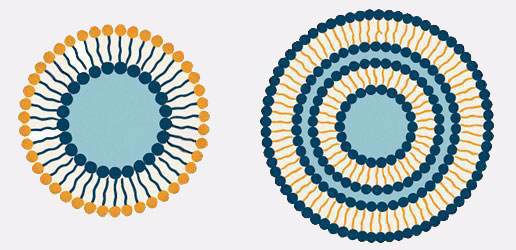
Fun Fact: Sederma created the first type of encapsulation technology in the beauty industry in 1985. It used liposomes.
2. Matrix systems
These solid or semi-solid particles consist of one continuous material that evenly disperses the active ingredient. Imagine a solid sphere of chocolate with nuts evenly distributed. These systems can be made of lipids, polymers and inorganic materials. For the lipid systems, there are two varieties:
Solid Lipid Nanoparticles (SLN)
These are nanoparticles composed of a solid lipid core (50 to 1000nm) surrounded by a surfactant.
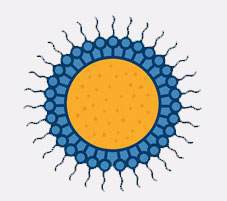
The active can either be incorporated in 3 ways:
- Evenly throughout
- Incorporated as part of the outer layer
- Incorporated in the centre
Nanostructured Lipid Carriers (NLC)
These comprise a mix of solid and liquid lipids and surfactants mixed at specific ratios. NLC’s are typically better for carrying a higher load of actives and avoiding expulsion during storage than SLN's.
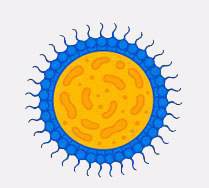
There are 3 types:
Imperfect - a loose structure where the solid lipid contains looser lipid regions which are ‘soft’ areas that create extra space for actives.
Multiple - Solid lipid containing oil regions which contain the active.
Amorphous – Non crystalline lipid structure which is less rigid than the first two types. It is a softer disordered structure which can give more room for the active depending on what phase the active prefers.(3)(4)(5)
NLC’s are typically better for carrying a higher load of actives and avoiding expulsion during storage than SLN's. [4]
3. Inclusion complexes
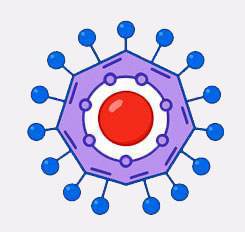
These are made up of a host molecule, that contains a cavity known as a molecular pocket. A guest molecule is carried within the molecular pocket to form a host-guest system.
Cyclodextrins are a known example: these donut shaped sugar molecules have a hollow centre which can be utilised to mask unpleasant odours in cosmetic applications.(6)
4. Core-shell capsules
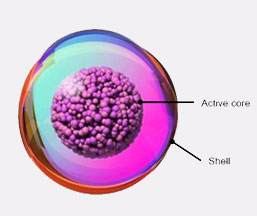
These capsules have two distinct elements. A distinctive core which usually contains the active ingredient, and a shell which is a separate material that protects the core. This type of encapsulation is the most widely used in the cosmetic industry because it can be made from a wide range of materials and is the easiest to create and incorporate into formulations.
Its physical protection and separation of the active ingredients help prevent incompatibilities. This type of structure also allows for higher amounts of actives to be incorporated within the system. The core is usually hydrophobic and surrounded by polymers or lipids. We have a wide range of fragrances that are encapsulated by this structure.
Encapsulation technologies are created to provide a protective layer around the beauty actives; however, it is important that the active level inside the encapsulate reaches the right efficiency to ensure the beauty active works to the right efficacy on the skin.
(1) Encapsulation in Cosmetics – Innovation in Skincare | Grand
(2) Shoji, Y., Igarashi, T., Nomura, H., Eitoku, T., & Katayama, K. (2012). Liposome solubilization induced by surfactant molecules in a microchip. Analytical Sciences, 28(4), 339–345.
(3) Technological strategies for the preparation of lipid nanoparticles: an updated review Stefan Stefanov1 , Viliana Gugleva1 , Velichka Andonova
(4) Lipid nanoparticles as novel delivery systems for cosmetics and dermal pharmaceuticals Carmelo Puglia† & Francesco Bonina † University of Catania, Department of Drug Sciences, Faculty of Pharmacy, Catania, Italy
(5) Haider, M., Abdin, S. M., Kamal, L., & Orive, G. (n.d.). Nanostructured lipid carriers for delivery of chemotherapeutics: A review.
(6) Cyclodextrin-based dermatological formulations: Dermopharmaceutical and cosmetic applications Melo a b, Sofia Rabaça a, Ankita Mathur c, Ankur Sharma d, Prabhanjan S. Giram e f, Kiran D. Pawar g, Abbas Rahdar h, Faisal Raza i, Francisco Veiga a b, Priscila Gava Mazzola j, Ana Cláudia Paiva-Santos a b